Welcome onboard
Enter as a new employee
The experience opens with a partial-access employee ID, then moves through fingerprint and facial recognition. Participation begins before anyone reads the fine print.
IONG 養
Concept
Food feels personal, but many choices are already shaped before we make them, through packaging, grocery systems, health tracking, and algorithms. IONG extends that condition into a future where food decisions become fully automated.
IONG reimagines food as a system rather than a choice, exploring how care and optimization can slowly reshape human autonomy.
Design goals
Show how a helpful system can quietly shape behavior and reduce autonomy.
Tie the fiction to health tracking, personalization, and AI-driven decisions.
Let curiosity and discomfort coexist instead of labeling the system as good or bad.
World
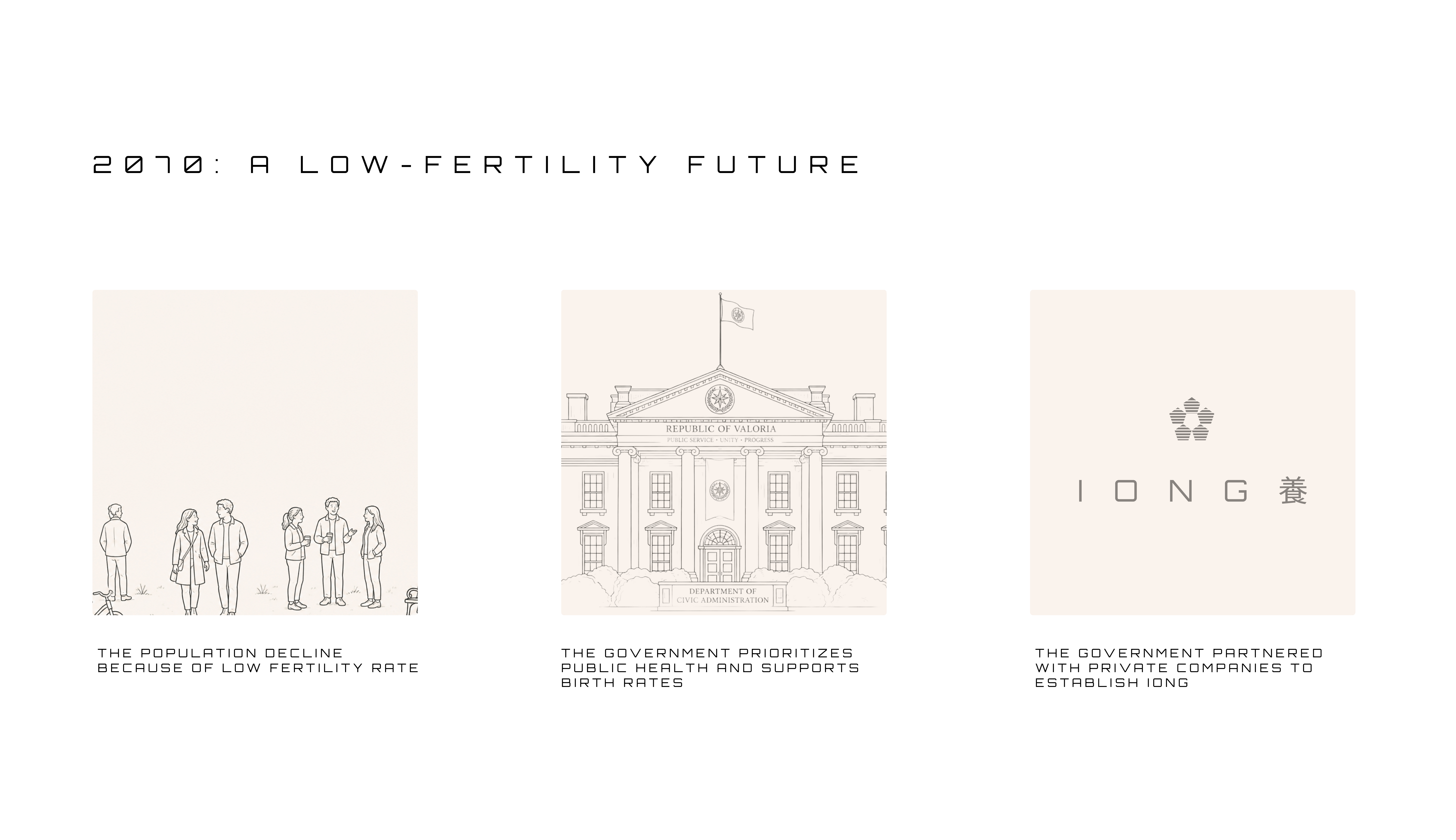
Declining birth rates and pressure on public health systems have turned food into a government-managed resource. IONG 養 is a centralized nutrition program that supports population health without ever describing participation as mandatory.
Citizens receive meals generated through continuous biometric analysis. The demo places you on the employee side of the institution, where care, scoring, monitoring, and access start to blur.
Experience
The demo has no fixed path. You enter with partial employee access, complete biometric scans, and explore departments freely. The system tracks reading time and interactions, then uses that behavior to assign your employee badge. You never choose a role directly; browsing becomes participation.
Welcome onboard
The experience opens with a partial-access employee ID, then moves through fingerprint and facial recognition. Participation begins before anyone reads the fine print.
Reflection
IONG was my final project at Pratt, a chance to experiment with worldbuilding and systems thinking outside the constraints of a typical product brief. Imagining a future where food is managed, not chosen, made me look more critically at the health apps, recommendation engines, and behavioral nudges that already shape everyday life.
This may not be a conventional UX project, but it became one of the most meaningful to me as a designer: building a fictional system coherent enough to feel plausible and close enough to the present to feel uncomfortable.