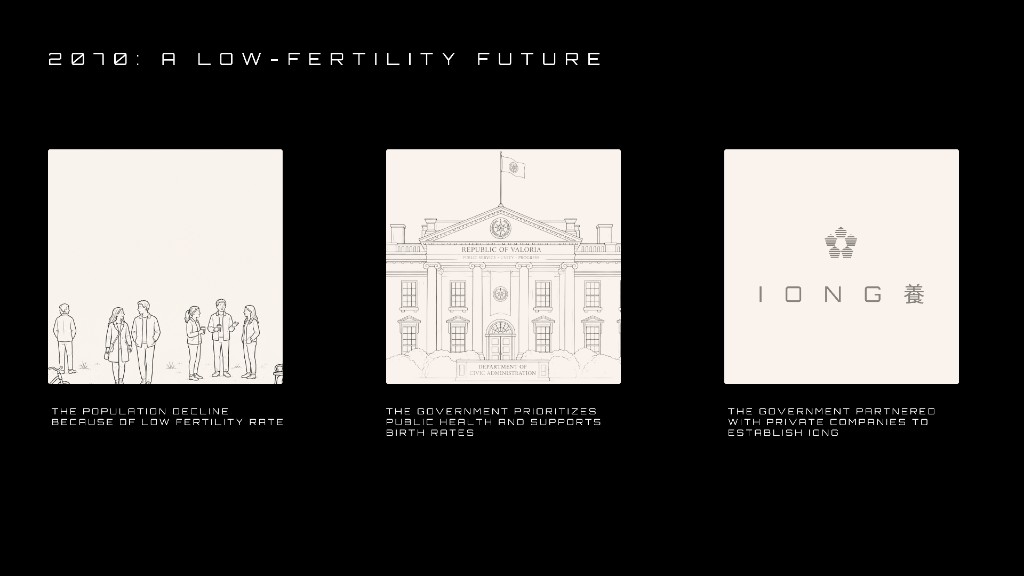
Declining birth rates and pressure on public health systems have turned food into a government-managed resource. The government partners with private companies to establish IONG 養, a centralized nutrition program that supports population health without ever describing participation as mandatory.
Citizens receive meals generated through continuous biometric analysis, using food made from processed surplus and alternative materials. The onboarding demo places you on the employee side of the system, revealing how health scoring, monitoring, and allocation operate from within the institution.
Design question
What happens when onboarding makes compliance feel voluntary?
Design goals
Explore automation and care
Examine how automated systems can appear helpful while quietly shaping behavior and reducing personal autonomy.
Connect speculation to the present
Link IONG’s world to current health tracking, personalized algorithms, and AI-driven decision-making.
No clear right or wrong
Present the system without defining it as purely good or bad. Curiosity and discomfort should coexist.
Experience
Employee onboarding as the experience
The onboarding demo has no fixed path. You enter with partial employee access, complete biometric scans, and explore the departments freely. Some sections remain locked behind clearance levels. The system tracks your reading time and interactions, then uses that behavior to determine the employee badge you receive. You never choose a role directly; browsing becomes a form of participation.
Welcome onboard
Mete Systems
Hæl Intelligence
Wēl Outreach
Lif Continuity
Lic Analytics
Employee badge
Welcome onboard
Enter as a new employee
The experience opens with a partial-access employee ID, then moves through fingerprint and facial recognition. From the first screen, the tone is institutional, helpful, and slightly unsettling. Participation begins before anyone reads the fine print.
The demo is the entry point. What follows traces how it was built, and why food became the subject.
Process
From object to employee onboarding
The onboarding demo was the final layer. IONG evolved from a physical speculative object into a connected digital ecosystem that examines how systems shape behavior through routine, restricted information, and small rewards rather than overt force.
01
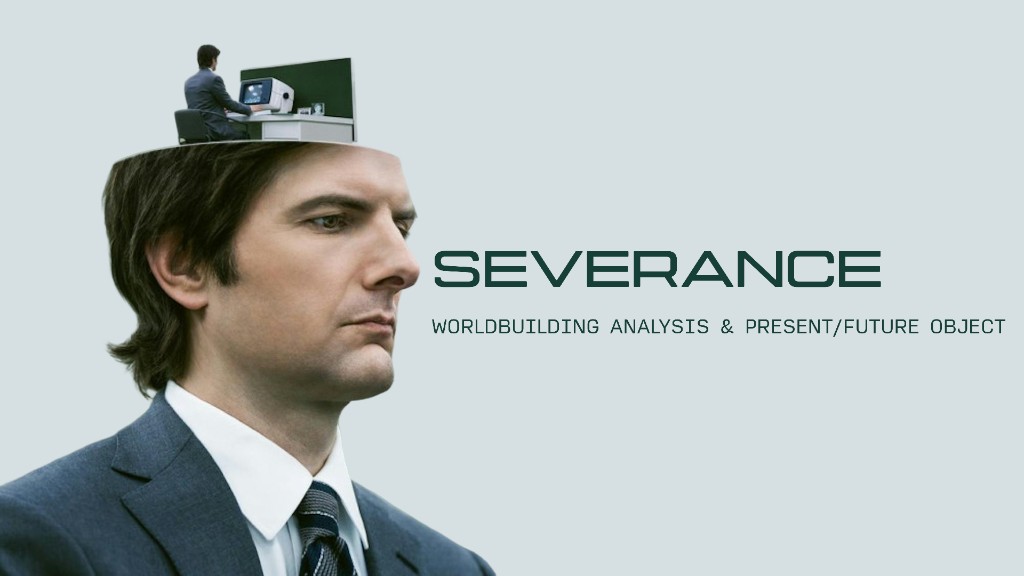
Severance analysis
I analyzed how Severance creates discomfort through minimal interfaces, limited transparency, and institutional environments that appear helpful while quietly restricting autonomy.
02
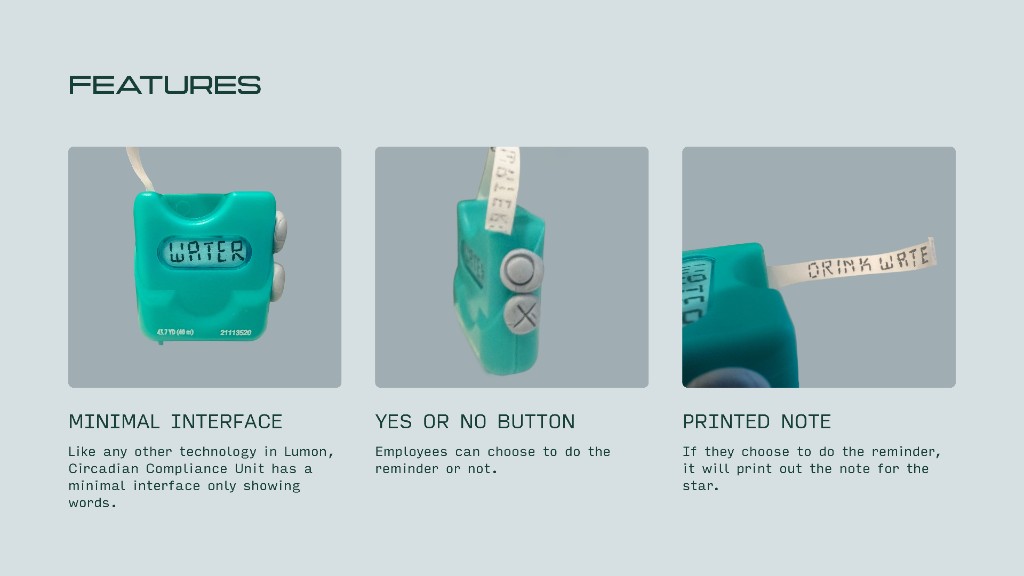
Circadian Compliance Unit
An early speculative device encouraged wellness compliance through reminders and small rewards. Limiting interaction to yes-or-no decisions became a foundation for IONG’s Health Credit Score and biometric monitoring.
03
Designing the food
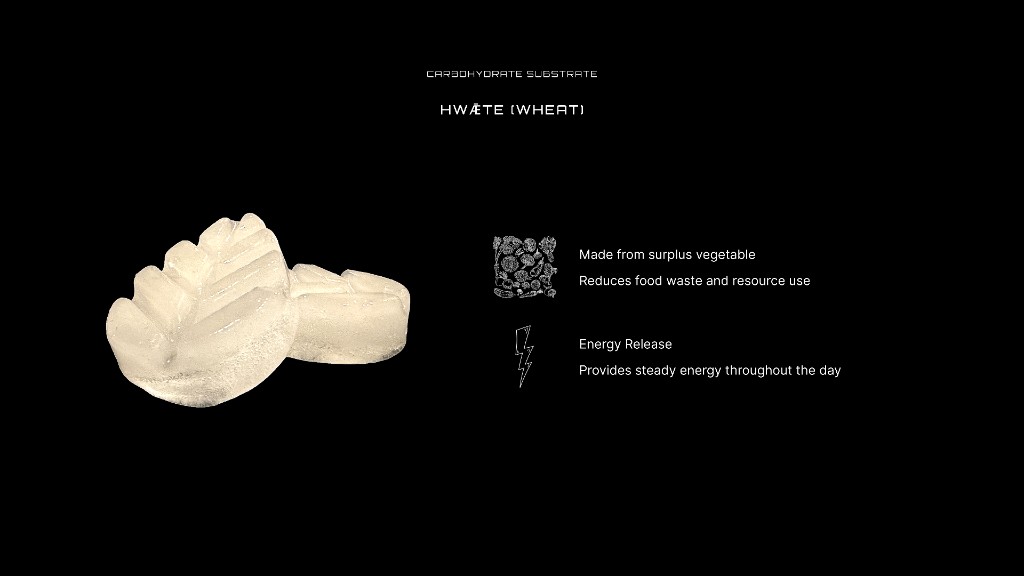
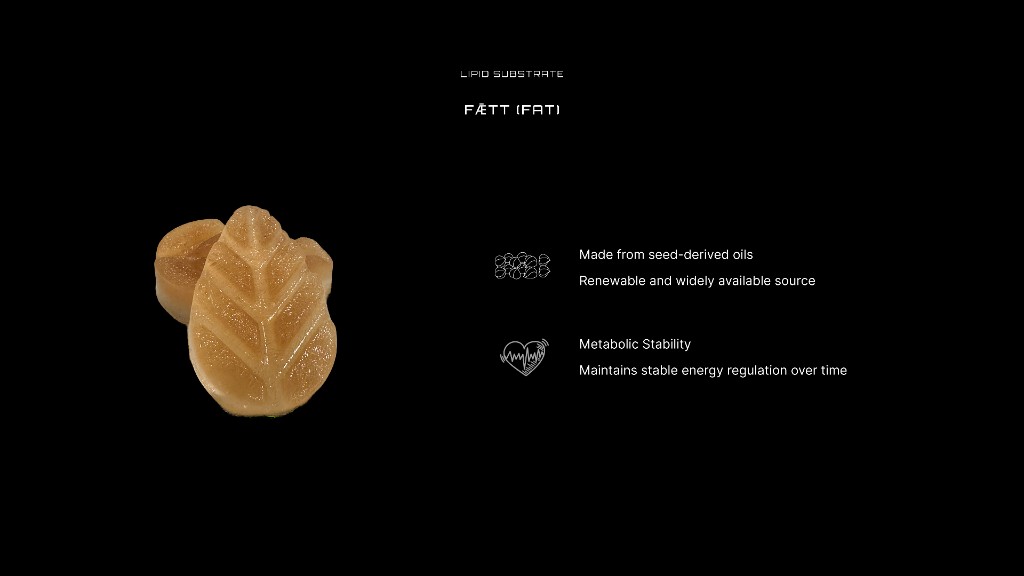
I simplified food into three macros, then iterated packaging, shape, and color. A leaf-shaped reference shifted the direction toward clean, systemized substrates: Flǣsc, Hwǣte, and Fǣtt.
04
From object to digital
IONG became a connected ecosystem of departments and interfaces. Loading screens evolved into an internal employee system; fingerprint and facial scans made onboarding feel like entering a controlled institution.
05
Sorting through interaction
Instead of asking users to choose a department, the demo tracks reading time and behavior, then assigns an employee badge. Simply interacting with the experience becomes a form of participation.
Severance analysis
Circadian Compliance Unit
Research
Why food? Because choice is already structured
Before the institution took shape, I looked at how food choice already works today. Food feels personal, but many decisions are shaped before we make them, through packaging, grocery layouts, health tracking, and recommendation algorithms. IONG builds on these existing systems and imagines what happens when the process becomes fully automated.
Packaging
Labels like “organic” and “high protein” shape what “good” food looks like before anyone reads the details.
Grocery systems
Eye-level placement and personalized rankings shape visibility long before a choice feels deliberate.
Health tracking
Calories, sleep, and biometric feedback turn eating into measurable optimization.
Social media
Algorithms repeatedly promote certain diets and wellness trends, normalizing some behaviors over others.
Literature review
Food choice is socially shaped
Drawing on Pierre Bourdieu’s Distinction, I treated food as culturally learned, not purely individual preference, which informed IONG’s institutional framing.
“Good” food is moralized
Labels like “healthy,” “clean,” and “natural” tie eating to responsibility and identity. This shaped systems like the Health Credit Score.
Everyday decisions are structured
Packaging, layouts, algorithms, and trackers organize choices before they feel conscious. IONG extends that condition into full automation.
Weak signals
Fewer options than we think
Recommendation systems filter what people see before decisions are made.
Food becomes data
Nutrition is increasingly evaluated through metrics and predictive health analysis.
Systems start deciding for us
Platforms move from suggesting choices to generating them. Users only approve or adjust.
System
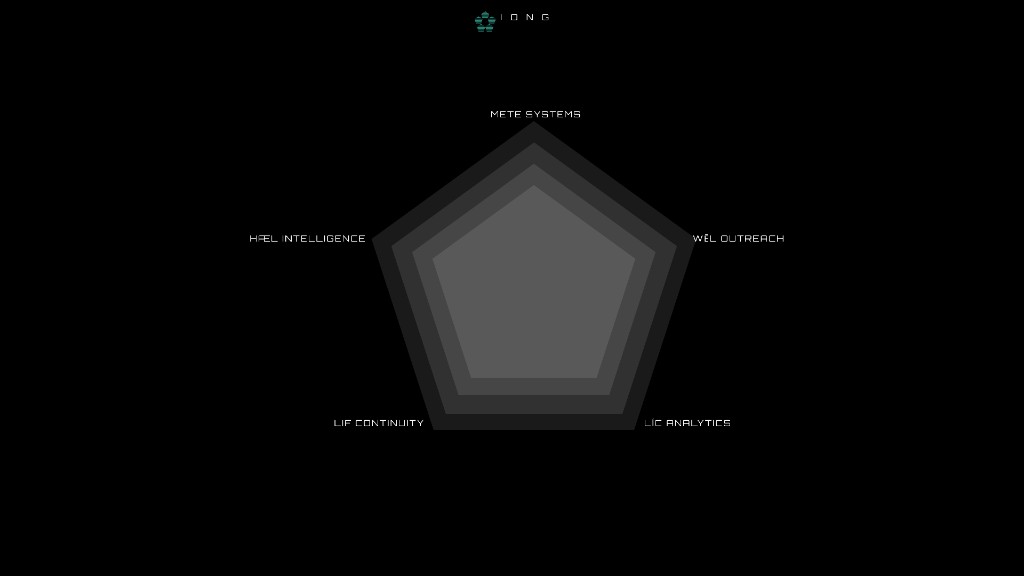
One centralized system, five departments
IONG operates through five connected departments. The onboarding experience grants partial access; this section maps what you can explore in the demo and what remains beyond your clearance.
In the demo
As a new employee, you can open Mete Systems, Hæl Intelligence, and Wēl Outreach. You also pass through biometric verification and, eventually, receive a badge.
Mete Systems
Surplus to sustenance. Collects and processes nutritional materials into daily sachets. Composition is not disclosed, and most processes remain invisible to the public.
Hæl Intelligence
Biometric data analysis. Uses wearable data to create daily nutrition plans for citizens and updates formulas in real time, while personal data remains siloed across departments.
Wēl Outreach
Trust and communication. Explains the Health Credit Score to citizens, shares updates, and serves as the primary link between the public and the program.
Hæl Intelligence · Citizen view
Real-time biometric tracking
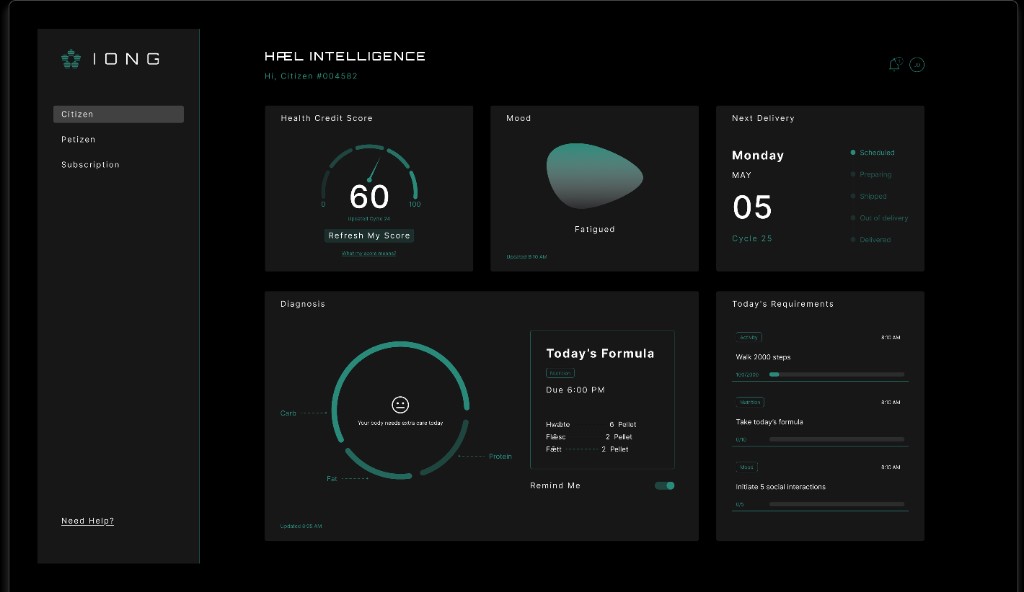
During onboarding, employees review the citizen dashboard: health scores, mood, delivery status, and today’s formula in one view. Continuous monitoring is presented as care before it reads as surveillance.
Wēl Outreach · Citizen view
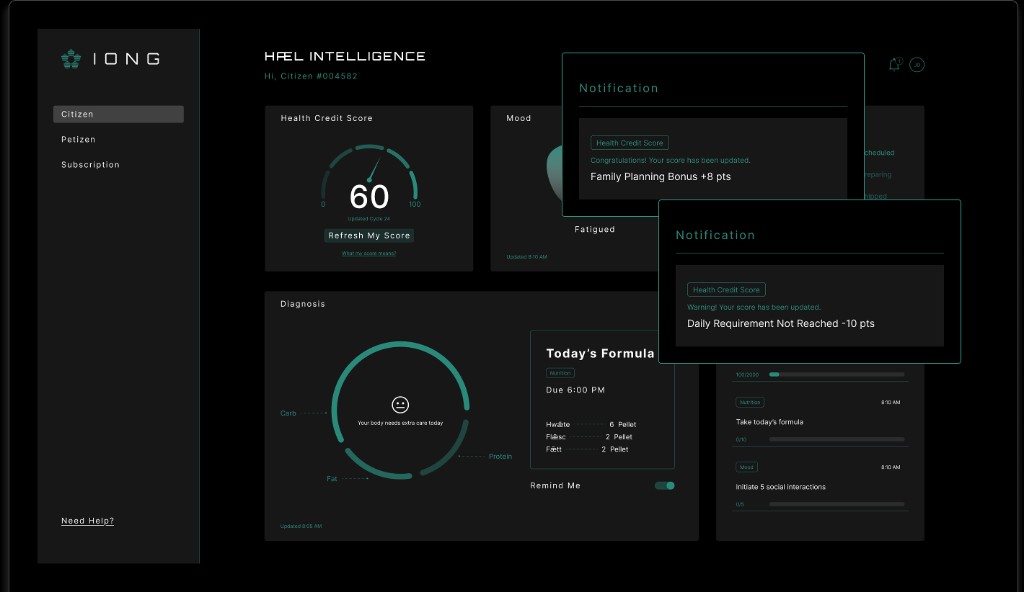
Behavior-based scoring
Employees see how Wēl communicates score changes to citizens. Family participation earns bonuses; missed daily requirements quietly reduce the score and access to stores and services.
Hæl Intelligence · Employee view
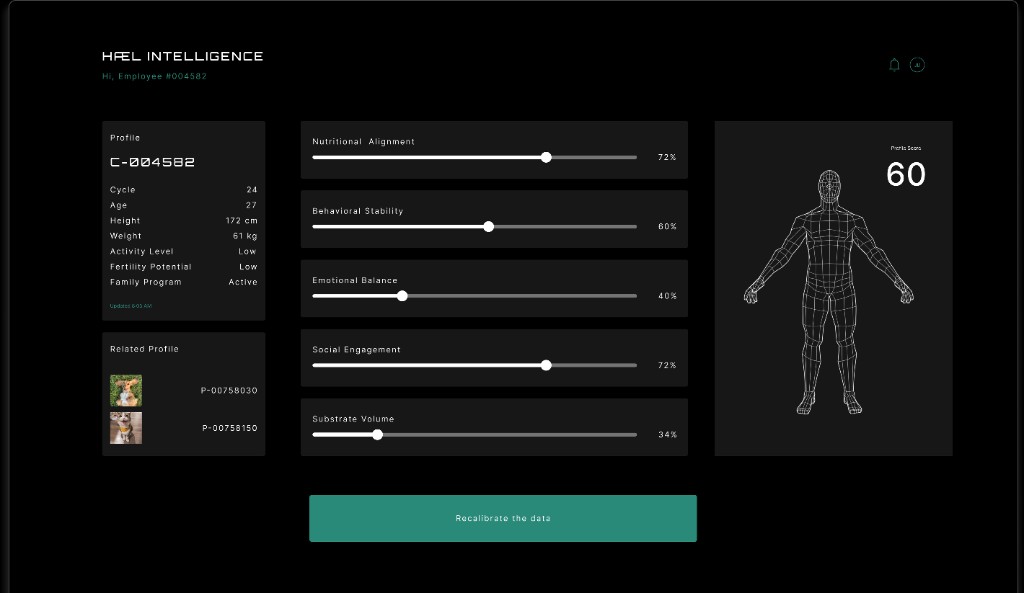
Daily data recalibration
Employees recalibrate citizen profiles to maintain stable nutritional and behavioral conditions. Small adjustments across alignment, mood, and engagement metrics keep the system optimized.
Outside your clearance
Lif Continuity and Lic Analytics stay locked during onboarding. Substrates, delivery, and Petizen extend the system into citizen daily life: context you read about on employee screens, not paths you walk yourself.
Lif Continuity
Population monitoring. You cannot access this department during onboarding. Your clearance level does not permit entry.
Lic Analytics
Data processing. You cannot access this department during onboarding. Your clearance level does not permit entry.
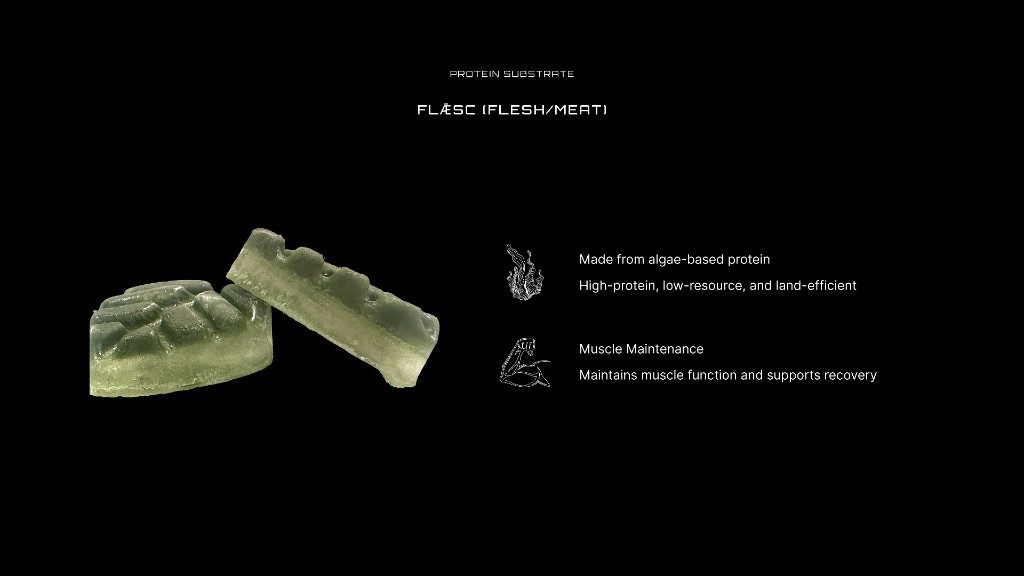
Protein
Flǣsc
Made from algae-based protein. High-protein, low-resource, and land-efficient, designed to maintain muscle function and support recovery.
Carbohydrate
Hwǣte
Made from surplus vegetables. Reduces food waste and resource use while providing steady energy throughout the day.
Lipid
Fǣtt
Made from seed-derived oils. A renewable, widely available source that maintains stable energy regulation over time.
Delivery
Personalized allocation, once per cycle
Citizens receive a personalized allocation once per 30-day cycle, exactly what the system calculates their body needs, without asking them to decide. Employees encounter this service as part of the program they help operate.
Petizen
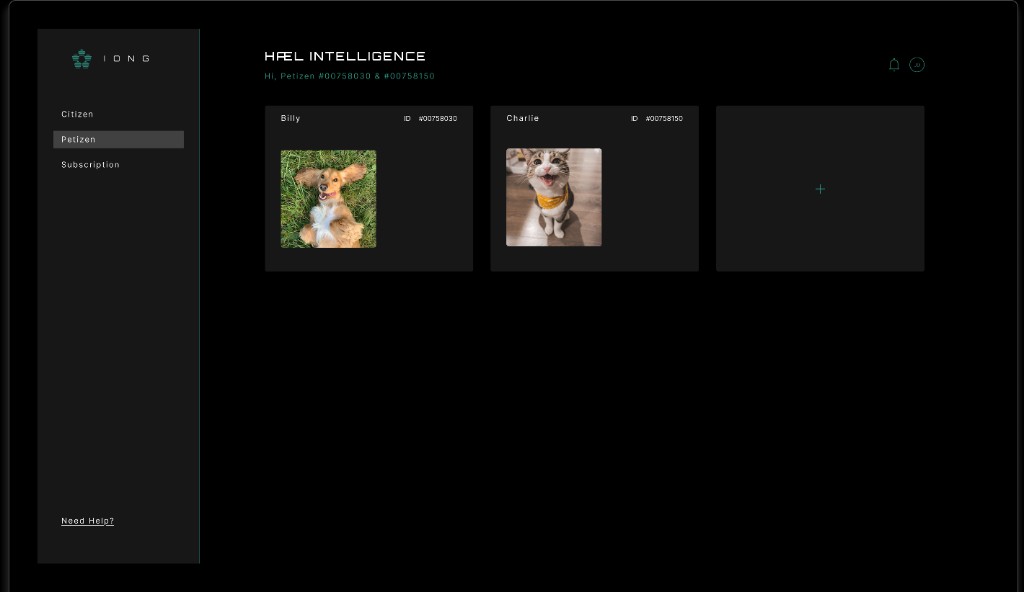
Pets are included in the system
Citizen household scoring extends to pets. Petizen profiles monitor health data and allow personalized nutrition. Employees see how deeply the system reaches into domestic life.
Reflection
Speculation as a mirror for the present
IONG was my final project at Pratt, a chance to experiment with worldbuilding and systems thinking outside the constraints of a typical product brief. Imagining a future where food is managed, not chosen, made me look more critically at the health apps, recommendation engines, and behavioral nudges that already shape everyday life.
This may not be a conventional UX project, but it became one of the most meaningful to me as a designer: building a fictional system coherent enough to feel plausible and close enough to the present to feel uncomfortable.